


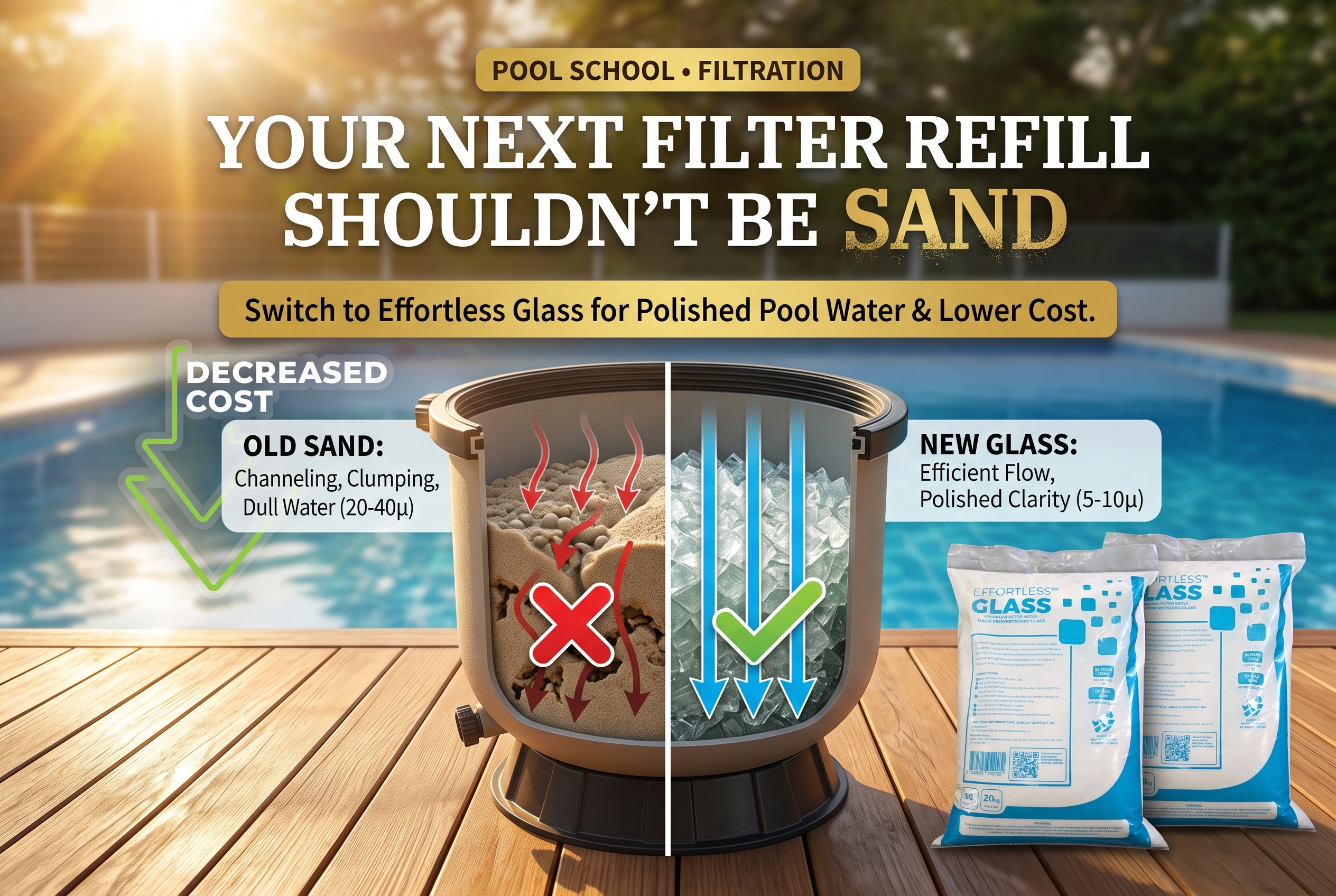
Your Next Filter Refill Shouldn’t Be Sand
Filter glass media goes straight into the sand filter you already own, catches particles your sand never could, and doesn’t wear out. If your media is due for replacement, this is the upgrade to make.
There is a bed of sand sitting inside your pool filter right now, quietly doing the single most important job in your whole filtration system. And in all likelihood, it is doing that job worse this season than it did last season — because sand wears out. Filter glass media doesn’t. That one difference is why glass has stopped being the interesting alternative and started being the obvious answer.
Most pool owners never think about filter media. It isn’t exciting. You can’t see it working, you don’t pour it into the pool, and nobody posts about it. But everything your pump pushes around your pool has to pass through that media bed, and what the bed catches is the difference between water that looks clean and water that is clean.
Think of your filter media as your pool’s liver. Everyone fixates on the pump, but the pump is only the circulation — it moves the water, it doesn’t clean it. The media bed is the organ that actually strips the impurities out before the water goes back in. You can fit the strongest pump on the market and still swim in dull water if the thing doing the filtering has quietly packed up.
So when the time comes to replace that media, it’s your one real chance to upgrade the organ. Buying another bag of sand wastes it.
What Filter Glass Media Actually Is
Filter glass media is 100% recycled soda-lime glass — bottles and container glass — that has been cleaned, crushed and graded to a precise particle size for pool filtration. It goes into your filter tank exactly where the sand goes, and your pump, multiport valve and plumbing don’t change at all.
The important part is the shape. Filter sand is quarried or river sand, and its grains have been rounded off by millions of years of erosion. Glass is crushed, so every grain is angular and irregular. Those sharp, mismatched shapes lock together into a bed with far more surface area and far more tiny gaps for dirt to be trapped in — and they refuse to settle into the neat, packed layers that cause sand’s biggest problems.
Three Things Sand Does That Glass Doesn’t
This isn’t a case of sand being fine and glass being slightly better. Sand has three specific, well-documented failure modes, and every one of them gets worse the longer the sand sits in your tank.
It channels.Water always takes the path of least resistance. Over time it carves narrow channels — sometimes called tunnelling or wormholing — straight through a packed sand bed. Water rushing down a channel is barely filtered at all. Your pressure gauge looks perfectly normal while a share of your pool water goes round the outside of the job.
It erodes and clumps.Every backwash cycle grinds the grains against each other. They round off further, break down into fines, and lose the edges that trapped debris in the first place. Oils, sunscreen and body fats bind the worn grains into clumps that no amount of backwashing will break up. This is why filter sand has a service life at all — in South African conditions you’re realistically looking at 18 to 24 months before performance falls away.
It harbours bacteria.As sand grains degrade they develop micro-pits and cracks. Those are perfect shelter for bacteria and biofilm, which sit deep enough in the surface to survive backwashing and keep drawing on your chlorine. Glass has a hard, smooth, chemically inert surface with nothing for organics to root into.
What You Actually Gain
The headline number is filtration fineness. Standard 20-grade silica sand captures particles down to somewhere around 20–40 microns. Published figures for glass media put it in the region of 5–10 microns.
To put that in perspective: a human hair is roughly 70 microns thick, and the naked eye stops resolving individual particles at about 40 microns. Sand filters right at the edge of what you can see. Glass filters well below it — and that invisible fraction is exactly what makes water look flat, dull or slightly milky even when your chemistry tests perfectly.
Filter Sand
Filter Glass Media
That difference in the tank shows up in four places you’ll actually notice:
Clearer water, not just clean water. Removing the sub-10-micron fraction is what gives water that hard-edged, polished look where you can read the tile grout at the deep end.
Shorter backwashes. Debris sits in the bed rather than binding to it, so it releases quickly. Less time on backwash means less water down the drain and less top-up water to re-balance and re-chlorinate.
Lower chemical demand. Every gram of organic matter your filter removes mechanically is a gram your chlorine doesn’t have to oxidise. Better mechanical filtration means your sanitiser spends its time sanitising instead of burning off dirt.
No mid-life decline. Sand is at its best the week you install it and worse every month after. Glass performs the same in year six as it did in week one.
Yes, It Goes In Your Filter
This is the question that stops most people, so let’s settle it plainly: if your filter takes sand, it takes glass. Filter glass media is a direct, drop-in replacement for the sand in a pool sand filter. There is no adapter, no modification, no new plumbing and no new valve. You take the old sand out and you put the glass in.
It works the same across chlorine pools, salt-chlorinated pools and pools running on alternative sanitisers, because the media bed’s job is mechanical — it strains particles out of moving water. And because glass is chemically inert, salt and chlorine have nothing to attack.
The only thing you need to get right is how much to put in, and that’s simple arithmetic.
How Much You Need
Glass is less dense than sand, so you need less of it by weight to fill the same tank. The manufacturer’s ratio is 120 kg of filter sand = 100 kg of glass media. In other words, take the sand weight your filter calls for and multiply by 0.83.
South African sand filters are sold by bag rating, where one bag means one 40 kg bag of sand. So a 3-bag filter holds 120 kg of sand. Here’s the conversion across the common sizes:
Glass Media Fill Guide
Effortless Glass is supplied in 20 kg bags.
Bag counts are rounded up — a little spare to top up with is far better than an under-filled bed. Not sure what your filter holds? Send us a photo of the tank and we’ll work it out for you.
“But Sand Is Cheaper”
It is, and we’re not going to pretend otherwise. Glass costs more up front — meaningfully more — and that’s the one honest mark against it. So let’s deal with it properly.
That premium pays itself back inside the first year. It comes back through your chemical bill, because every particle the media strips out mechanically is a particle your chlorine doesn’t have to burn itself out oxidising. It comes back through your water bill, because glass releases debris quickly and backwashes short instead of long — less water down the drain, and less top-up water to re-treat and re-balance. And it comes back through your time, because a filter that’s actually filtering doesn’t need chasing.
After that first year, everything is upside. Sand gets pulled out and replaced every 18 to 24 months, and it spends the back half of that stretch underperforming. Glass is rated for six years and, because it doesn’t erode, in practice it goes well past that. Over ten years that’s five or six sand change-outs against a single glass fill — and five or six mornings of your life spent shovelling wet sand out of a tank.
Making the Switch
A media change-out is a solid morning’s work, but it’s well within reach if you’re comfortable with your own equipment. Switch the pump off at the isolator and close your valves before you open anything.
Remove the old sandOpen the tank and empty out every bit of the existing media. A wet-vac or a small scoop makes short work of it. Don’t leave a layer at the bottom — old sand under new glass defeats the point.
Rinse the tank outFlush the empty tank clean and check the laterals at the bottom for cracks or breaks while you have clear access. It is far easier to replace a damaged lateral now than after the tank is full.
Cover the inlet pipeSlip a plastic bag over the top of the standpipe and tape it. This stops media dropping down the inlet pipe while you fill, which would send it straight into your pool.
Fill to the lateralsAdd glass media until the laterals are properly supported and buried. Pour steadily and evenly around the standpipe so the bed sits level rather than heaping to one side.
Top up with the restAdd the remaining media to bring the bed up to your filter’s fill level. Keep the standpipe centred as you go.
Remove the bag and close upTake the plastic bag off the standpipe, clear any media off the tank lip and sealing face, and refit the multiport valve or lid.
Backwash and rinseSet the valve to backwash and run for 30 seconds, then rinse for 10 seconds. This flushes out manufacturing fines and beds the media down. Then set it back to filter and you’re done.
Keep filter glass media away from children and animals, and out of the hands of anyone who doesn’t know what it is. If any gets in your eyes, flush with plenty of clean water and get medical attention if irritation persists. If a significant quantity is swallowed, seek medical attention immediately. The first backwash will clear any fine fragments left over from manufacturing — don’t skip it.
One More Thing Worth Knowing
Filter sand is silica sand, and dry silica sand generates respirable crystalline silica dust when you tip and pour it. Respirable crystalline silica is a recognised occupational health hazard — it’s the reason sandblasting and stone-cutting are so heavily regulated. Recycled soda-lime glass media contains no free crystalline silica.
For a homeowner doing one media change every few years the exposure is small, but if you’re a pool service technician emptying and filling filters week after week, it’s a legitimate reason on its own to move your customers across.
And It’s Made Here
Effortless Glass is proudly manufactured in South Africa from glass diverted out of the local waste stream. Every 20 kg bag is container glass that would otherwise have gone to landfill, turned into something that will sit in a filter doing useful work for the better part of a decade.
It’s a rare case where the environmental argument and the performance argument point in exactly the same direction, so we’ll take it.
Effortless Glass Premium Filter Media
Premium filter media made from 100% recycled South African glass. Angular grain structure for improved surface area and depth filtration, superior chemical resistance, and a hard surface that won’t clump, channel or shelter bacteria. Drops straight into any pool sand filter.
Quick Questions
Is glass media better than sand?
Yes. It filters finer, it doesn’t channel, it doesn’t erode or clump, it resists biofilm, it backwashes faster, and it outlasts sand several times over. Sand’s only advantage is a lower price on the day you buy it — and that advantage is gone within a year.
Can I put glass media in my sand filter?
Yes. Filter glass media is a direct replacement for the sand in a pool sand filter. No modification, no new equipment. Take the sand out, put the glass in, backwash and rinse.
Do I need the same weight as my sand?
No — glass is less dense, so you need about 17% less by weight. The rule is 120 kg of sand equals 100 kg of glass. Use the fill guide above, or send us your filter details and we’ll work it out for you.
Will it make my water clearer?
It removes a much finer fraction of suspended particles than sand does, which is what produces that polished, hard-edged clarity. Filtration is one of three legs though — you still need proper circulation run time and balanced water chemistry to see the full benefit.
Does it work with a salt chlorinator?
Yes. Glass is chemically inert, so salt and chlorine have nothing to degrade. It works equally well on chlorine, salt-chlorinated and alternatively sanitised pools.
How do I know when it’s time to switch?
If your sand is 18 months old or more, if your water looks dull despite balanced chemistry, if you’re backwashing more often than you used to, or if you’re pulling out clumped sand — it’s time. And if you’re replacing your media anyway, there is no reason on earth to put sand back in.
Stop Replacing Sand. Upgrade Once.
Effortless Glass filter media, sand filters, pumps and everything else your filtration system needs — factory direct from Pool DC, delivered across South Africa.