


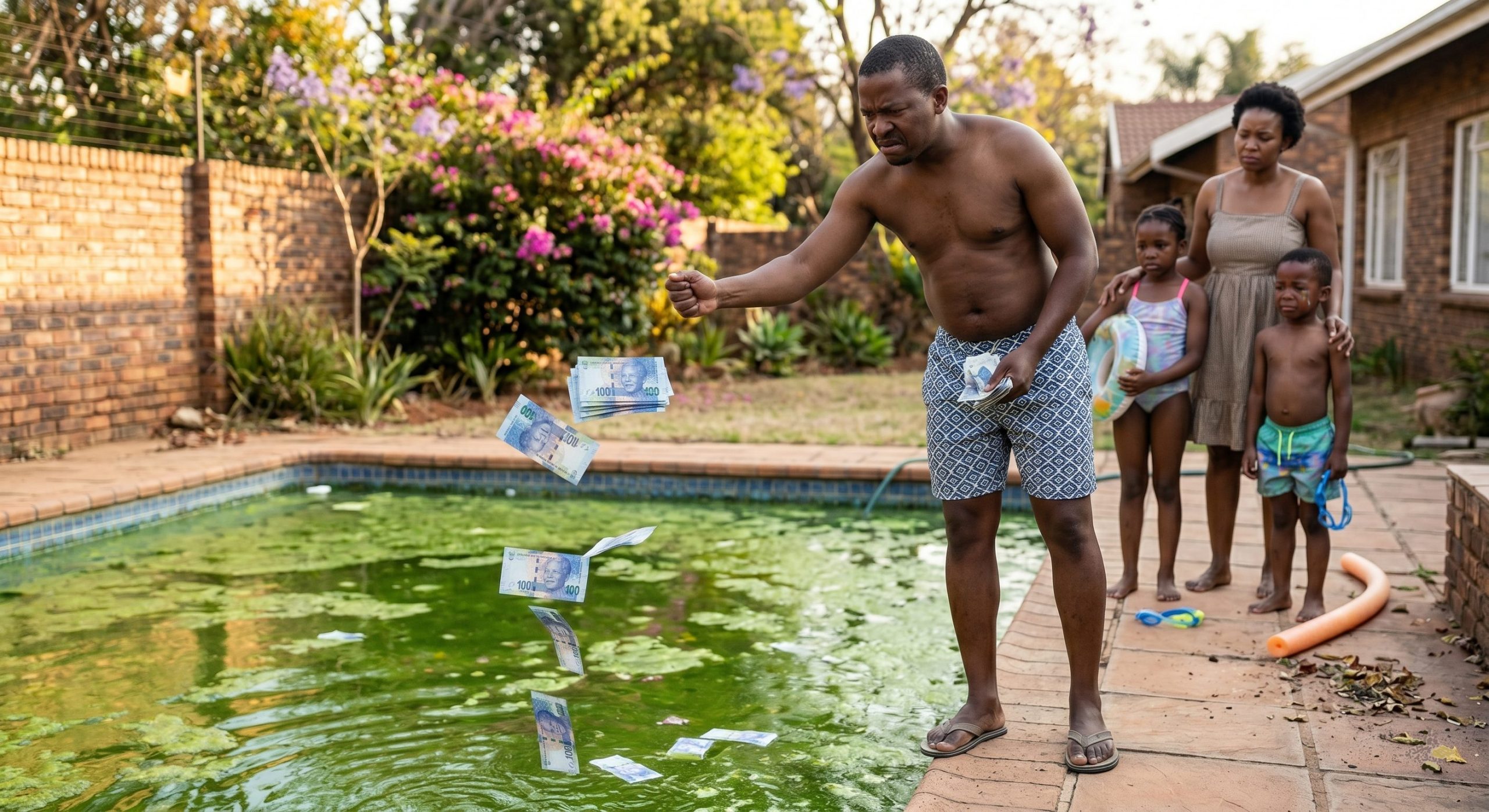
Winter Pool Care That Saves You Thousands
Twenty minutes a week through winter, or a green swamp and a R4,000 recovery bill come September. Here’s the simple routine that keeps your pool ready to swim.
Your pool doesn’t stop being a pool just because nobody is swimming in it. While you’re inside keeping warm, your pool is still a living body of water — and without a basic winter routine, it quietly turns into an expensive problem. Algae takes hold, water chemistry drifts, debris decomposes, and equipment sits idle long enough for seals to dry out and components to seize.
The result? Come September, you’re looking at a green swamp that needs shock treatments, extended pump runs, chemical rebalancing, and sometimes a full drain and refill just to get it swimmable again. That recovery can easily cost R2,500–R4,000 in chemicals, water, electricity, and professional call-outs.
The alternative? About R150–R250 a month in reduced chemicals and one hour of daily pump time. That’s it. A little attention through winter and your pool is ready to swim in the moment the first warm day hits.
The Real Cost of Neglect: Let’s Do the Maths
Here’s what happens when you abandon your pool from April to September — roughly 5 months — versus keeping a basic winter routine going.
Scenario 1: You neglect the pool
When you open it up in September, a neglected green pool typically requires multiple shock treatments, algaecide, pH correction, clarifier, and potentially a water top-up or full refill if it’s beyond saving. Professional green pool recovery services in Gauteng start from R1,200 and can run to R4,000 depending on severity. On top of that, you’ll need to run your pump for 12–24 hours continuously for several days to clear the water — that’s 4–5 times your normal daily electricity cost.
Add in the risk of equipment damage from sitting idle (a pump shaft seal replacement alone costs R400–R1,200 including labour), and you’re looking at a realistic recovery bill of R2,500–R4,000 or more.
Scenario 2: You maintain a simple winter routine
Running your pump for just 1 hour a day in winter (down from 3–4 hours in summer) costs roughly R80–R110 a month in electricity (based on a standard 1.1kW pump at current Eskom rates of around R2.50–R3.30/kWh depending on your municipality). A fortnightly dose of chlorine and the occasional pH adjustment might add another R80–R120 a month in chemicals.
Winter routine vs the September bill
Figures based on a standard 1.1kW pump and current Gauteng tariffs and recovery rates. Your costs will vary with pool size, municipality and pool condition.
Compare that to the R2,500–R4,000+ recovery bill in September, and the maths speaks for itself. You save money, you save time, and you avoid the stress of staring at a green pool on the first warm weekend of the year.
Why Your Pump Must Still Run in Winter
This is the one thing pool owners get wrong more than anything else. They switch the pump off in April and don’t touch it until September. That’s five months of a motor sitting stationary, seals drying out, and water going stagnant.
Mechanical seal damage
Your pool pump has a mechanical shaft seal that sits between the wet end (where the water is) and the motor. This seal relies on a thin film of water to stay lubricated. When the pump doesn’t run, the seal dries out. Dry seals crack, warp, and eventually fail — and a failed seal lets water leak into the motor, which destroys it. A few seconds of dry running can cause heat cracks or blisters on the seal face. Five months of sitting dry is far worse.
An estimated 75% of pool pumps that fail prematurely do so because water intrusion from a failed shaft seal damages the motor. A new pump costs R2,500–R8,000 depending on the model. A replacement shaft seal is R160–R400 in parts alone, plus labour. Either way, it’s money you didn’t need to spend.
Stagnant water
Without circulation, your pool water becomes a breeding ground for bacteria, algae, and mosquitoes. Chemicals can’t distribute evenly if the water isn’t moving. Dead spots form — particularly in corners and around steps — where algae spores settle and take hold. Once algae establishes itself on the walls and floor, it’s far harder (and more expensive) to remove than preventing it in the first place.
What to do
Reduce your pump run time to 1 hour a day in winter. That’s enough to circulate the water, distribute chemicals, and keep the mechanical components lubricated. Set your timer to run during off-peak electricity hours to save even more. If you have a variable-speed pump, drop it to a lower RPM — you’ll use a fraction of the electricity while still keeping the water moving.
Winter Water Chemistry: It Still Matters
Just because nobody is swimming doesn’t mean your water chemistry takes care of itself. In fact, winter introduces its own set of challenges — especially on the Highveld.
Dust and dry conditions
Gauteng’s dry winter months bring Highveld dust and wind. Fine dust particles settle on the water surface and sink, increasing the total dissolved solids (TDS) in your water. Dust is alkaline, so it pushes your pH upward. Leaves and organic debris that blow in decompose on the pool floor, consuming chlorine and feeding algae spores. Without regular skimming and circulation, this debris builds up fast.
pH drift
In winter, with less UV exposure and no bather load, you’d expect water chemistry to stay stable. But pH has a tendency to drift upward during the dry months — partly from dust, partly from reduced acid rain (which naturally lowers pH in summer), and partly from the concrete/marbelite surfaces of the pool slowly leaching calcium into static water.
If your pH climbs above 7.8, your chlorine becomes dramatically less effective. At a pH of 8.0, only about 20% of your free chlorine is actively sanitising the water — even if your chlorine reading looks fine on the test kit. This is how pools turn green despite appearing to have adequate chlorine levels.
Alkalinity
Total alkalinity acts as the bodyguard of pH — it buffers your water against sudden swings. The ideal range is 80–120 ppm. If alkalinity drops too low, your pH will bounce around unpredictably. If it climbs too high, your water becomes cloudy and scale starts forming on the plaster and equipment. Testing alkalinity fortnightly in winter and making small adjustments is far cheaper than dealing with scaling or etching damage in spring.
Calcium hardness
This is the one most pool owners forget entirely. Your pool water wants calcium — and if it doesn’t have enough (below 200 ppm), it’ll take it from the marbelite or plaster surface, causing etching and roughening. Too much calcium (above 400 ppm) and you get scaling on surfaces and inside your filter and pipes. In winter, with reduced water movement and higher evaporation-to-refill ratios, calcium levels can creep up. A simple test every month or two keeps this in check.
What to do
Test your water fortnightly through winter. At minimum, check pH and chlorine levels — ideally check alkalinity too. An Aqua Max Dual Test Kit costs under R200 and gives you pH and chlorine readings in under a minute. Keep DPD refill tablets on hand so you never run out mid-winter.
Dose chlorine weekly at a reduced rate. A chlorine floater like the Aqua Max Floating Pill Dispenser with stabilised chlorine tablets is the easiest winter option — it releases a steady, low dose of chlorine without you having to think about it.
Your Simple Winter Pool Routine
Winter pool care doesn’t require hours of work. A basic routine of about 20 minutes a week is all it takes.
Weekly- Run the pump for 1 hour daily (set your timer and forget it)
- Skim the surface and clear the weir basket — remove leaves and debris before they decompose and consume chlorine
- Top up chlorine if needed (or let your floating dispenser do the work)
- Test pH and chlorine levels with your test kit and adjust if necessary
- Brush the walls and floor — this prevents algae from taking hold on surfaces, especially in shaded areas and corners
- Check the pump for any signs of leakage around the seal plate
- Backwash the filter to maintain flow and filtration efficiency
- Check the water level — winter evaporation is lower than summer, but wind and dry conditions still drop levels. A low water level can cause the pump to lose prime and run dry
- Inspect your pool cleaner hoses for cracks or damage (animals chewing hoses is a common cause of pump prime loss)
- Get a full water analysis done (pH, chlorine, alkalinity, calcium hardness, stabiliser/CYA). Many pool shops offer this free. It gives you a complete picture and lets you correct any drift before it becomes a problem
Protect Your Equipment
Winter is the ideal time to give your equipment a health check. With the pool out of heavy use, you can inspect, service, and replace components without disrupting anyone’s swimming.
- PumpRunning it daily keeps the seals lubricated and the bearings turning. Listen for grinding or screeching sounds — these indicate worn bearings. Check under the pump for drips, which signal a failing shaft seal. Catching a leaking seal early is a cheap fix; ignoring it leads to motor failure.
- FilterBackwash monthly. If your filter sand is more than 2–3 years old, winter is the time to replace it. Old, channelled sand loses its filtration effectiveness and you end up running the pump longer for worse results.
- Pool cleanerPull it out for the winter if you’re not using it regularly. Leaving it in the pool for months without running can cause hoses to stiffen, warp, or crack. Store hoses in a cool, shaded area — not coiled in direct sunlight.
- Valves and O-ringsCheck multiport valves, union fittings, and pump lid O-rings. Dry winter air can cause rubber seals to perish. A pump lid O-ring costs R12–R40. A pump that runs without prime because of a cracked O-ring costs you a shaft seal — or worse, a motor.
Don’t Forget Your Solar Panels
If your pool has a solar heating system, don’t make the mistake of shutting it down for winter. Solar panels that sit unused for months can become brittle — the UV-stabilised materials are designed to have water flowing through them, and prolonged dry stagnation combined with winter UV and temperature swings degrades them faster than normal use ever would.
Keep running your solar system periodically through winter, even if you’re not heating the pool. A short cycle a few times a week keeps the panels conditioned and prevents the internal channels from drying out and becoming fragile.
Install a vacuum breaker
Water must never be left sitting in the solar panels overnight during winter. On cold Highveld nights, temperatures can drop below zero — and if water freezes inside the panels, it expands and cracks the internal channels. That kind of damage is irreparable, and you’re looking at replacing panels entirely.
A vacuum breaker (also called a vacuum relief valve) allows water to drain back out of the panels automatically when the pump switches off. Without one, water stays trapped in the panels at roof height with no way to drain. When the pump stops, the vacuum breaker opens, breaks the siphon, and lets gravity pull the water back down into the pool.
If you don’t already have a vacuum breaker installed on your solar system, get one fitted before winter sets in. It’s a small, inexpensive fitting that protects panels worth thousands of rands.
Browse Solar Panel Fittings at Pool DC →
Winter Is Also Makeover Season
If you’ve been meaning to resurface, repaint, or upgrade your pool, autumn and winter are the ideal time to do it. The pool isn’t in use, contractors are less busy, and any new surfaces have months to cure properly before swimming season returns.
Thinking of a pool makeover?
We’ve written a complete guide on painting your pool in winter using Cemcrete Pool Coating — when to do it, how to prep, and why the timing matters.
Read the Pool Painting Guide →Whether it’s a fresh coat of pool paint, new waterline mosaics, or a pump upgrade, doing the work now means you don’t lose a single day of summer swimming.
Frequently Asked Questions
How many hours should I run my pool pump in winter?
1 hour a day is enough for most average-sized residential pools. This keeps the water circulating, chemicals distributed, and the pump’s mechanical seal lubricated. Set your timer to run during off-peak electricity hours to reduce costs.
Can I turn my pool pump off completely in winter?
No. Switching the pump off for extended periods allows the mechanical shaft seal to dry out and crack, which leads to water leaking into the motor. It also means zero water circulation, which leads to stagnant water, algae growth, and bacterial contamination. Even 1 hour a day is enough to prevent these problems.
How much does it cost to recover a green pool in South Africa?
Professional green pool recovery in Gauteng typically costs R1,200–R4,000 depending on severity. If you’re doing it yourself, expect to spend R400–R1,200 on shock treatment chemicals, algaecide, clarifier, and acid — plus significantly higher electricity costs from running the pump 12–24 hours a day for several days.
How often should I test my pool water in winter?
At least fortnightly. Check pH and free chlorine as a minimum. Ideally, test alkalinity monthly and get a full water analysis (including calcium hardness and CYA) at least once during winter.
What chemicals do I need in winter?
At a minimum: granular or stabilised chlorine to maintain sanitiser levels, and pool acid (hydrochloric acid) to correct pH if it drifts above 7.6. A chlorine floater with stabilised tablets is the simplest set-and-forget option for winter.
Does dust really affect pool water chemistry?
Yes. Fine dust — especially Highveld dust — is alkaline and raises your pH when it settles into the pool. Combined with decomposing leaves and organic matter, dust increases total dissolved solids and places additional demand on your chlorine. Regular skimming and fortnightly testing keeps this in check.
Is it worth using a pool cover in winter?
Absolutely. A quality pool cover reduces debris, slows evaporation, retains heat, and significantly reduces chemical consumption. It also means less cleaning for you.
Should I keep my solar panels running in winter?
Yes. Solar panels that sit unused for months can become brittle and degrade faster. Run them periodically through winter to keep them conditioned. Critically, make sure you have a vacuum breaker installed so that water drains out of the panels when the pump switches off — water left in the panels overnight can freeze and crack them beyond repair.
Shop Winter Pool Essentials at Pool DC
Keep your pool ticking over this winter with the right chemicals and testing equipment — at factory-direct prices with nationwide delivery. Twenty minutes a week and a couple of hundred rand a month is all it takes to save yourself thousands come summer.
Browse Chemicals & Testing →